Around it a set of posh buildings have emerged and the Lake was thought to be
beautified. The lake will also be cleaned and desalted, which by itself is a
good thing. But people who matter have not thought of the crocodiles that
inhabit this lake.
The beautification of the lake and its surroundings must take into account
the welfare of the original inhabitants of this lake, the crocodiles. These
number about 70 in all and have been home here for many decades. There is no
doubt that the crocodile life style will be affected adversely after the entire
beautification plan is gone through.
Firstly the crocodiles may not have access to the shores of the lake. The crocodiles use these shores every
day to bask in the sun. The culprit is the constructed parapet walls which will
be too steep for the crocodiles to climb and come onto the land. It is matter of
regret that nobody thought of the crocs in the lake, so intent they were in
trying to beautify the lake for man.
The crocodiles are a precious commodity and in the present environment, where
wild life is at a premium, their survival is in the interest of everybody. The
lake itself needs to be cleaned and is still dirty with sea weeds and garbage
floating around. In fact during the immersion festivals during Ganpathy pollute
the Lake to no end. This also needs to stop. Surely no God wills continence
destruction of any natural habitat.
It should not be forgotten that along with the crocs, the lake is a habitat
for several bird species, who will also be disturbed with the water fountains in
the lake at a number of places. It is a matter of regret that no wild life
expert was consulted for this beautification drive. It is still not late and it
is hoped that the natural habitat of the crocs in Powai Lake will not be
destroyed.
Tuesday, August 7, 2012
Wednesday, May 16, 2012
Orinoco Crocodiles Are One Of The Most Highly Endangered Of All Crocodilians

She will dig out the youngsters, carry them to the water and she will defend them until they are a year old. "For handbags, belts, and shoes, Orinoco crocodiles in South America were hunted ruthlessly for decades. By the mid-1960s they had been nearly wiped out in the Orinoco River Basin of Venezuela and Colombia. In 1976 hunting was banned, but the damage was done: A census found fewer than 300 animals. Conservationists and scientists have worked hard to bring back this beleaguered reptile, which can exceed 20 feet [6 meters] in length. Four captive breeding centers in Venezuela have reared and released more than 1,300 crocodiles into the Orinoco and its tributaries since 1990."
The Orinoco crocodile is one of the larger crocodilians (a group that also includes alligators, caimans and the gharial), with a relatively narrow snout and a minor swelling in front of the eyes. It is South America's largest predator, by mass, and males have been reported up to 7 metres in length, although the maximum size recorded in recent studies has not exceeded 5 metres. Three different colour variations exist with the most common being 'Amarillo': a light tan body and scattered dark areas. In captivity, it has been noted that the skin can change colour over long periods of time; this phenomenon has been recorded in other species that can gradually change the amount of melanin in their skin (2)(4).
Range
Severely fragmented populations are found in the lower reaches of the Orinoco River in Venezuela and Colombia.
Habitat
Once associated with a wide variety of habitats (from tropical forests to the streams of the Andes foothills), this species has now been restricted to the Llanos savannah and associated seasonal freshwater rivers.
Biology
When the waters subside in the dry season, Orinoco crocodiles retreat into burrows excavated into riverbanks. Breeding females excavate hole-nests on exposed sand banks, typically laying around 40 eggs. The female remains close to the nest site to guard it from vultures and tegu lizards. Hatching occurs 2.5 to 3 months later, which coincides with the rains that bring a rise in water levels, and females have been reported to protect pods of juveniles for up to 3 years.
Adults are opportunistic, feeding on a wide variety of prey that are either in or near the water such as fish, large birds and small mammals. Data on lifespan are extremely sparse but, like other large crocodilians, Orinoco crocodiles may live as long as 70 to 80 years.
Threats
The Orinoco crocodile was hunted to the brink of extinction for its skin during the 1930s to 60s and the population has shown little signs of recovery since, although reintroduction programs are underway. Crocodiles could be found in large numbers around small water areas during the dry season, which made them easy targets for hunters. Today there are an estimated 250 to 1,500 individuals left in the wild. Illegal hunting for meat and for teeth (which are thought to have medicinal properties), along with the collection of eggs and juveniles remains the major threat to this species. Further threats are posed from continued habitat destruction, killing by local people, and from competition with the spectacle caiman (Caiman crocodilus), which is found in the same area.
Conservation
Orinoco crocodiles are one of the most highly endangered of all crocodilians due to the small size and highly fragmented nature of their population. International trade in this species is banned under Appendix I of the Convention of International Trade in Endangered Species (CTIES), and it is protected throughout much of its range. These protection measures however, are largely ineffective and unforced and illegal poaching remains the principal threat to this species. In Colombia very little is known about the current status of the species and this remains a high priority for any conservation action plan. In Venezuela a reintroduction/ restocking plan has been developed and captive breeding is carried out at a number of sites. Effective monitoring of released crocodiles is required and protection measures need to be properly enforced, in order to help this species recover from such crippling over-exploitation in the past.
Sunday, May 6, 2012
Facts And Information About Siamese Crocodiles

The word crocodile has got its origin from the ancient Greek word crocodilos which was used for lizards. The crocodiles are among the most complex reptiles which have a completely four chambered heart and well developed cerebral cortex and complete diaphragm and muscles adapted for locomotion. The external morphology is best suited for its aquatic mode of life. The body is streamlined in shape which allows it to swim swiftly in water. They possess webbed feet which are a perfect adaptation for aquatic mode of life and it reduces resistance while swimming. In crocodiles the back portion of mouth bears a palatal flap which prevents the entry of water into the mouth when they are in water. The nostrils are closed when they are under water. The brain case is bony and lacks the supratemporal and postfrontal bones. Their tongues are attached to the mouth by a delicate membrane so they are unable to stick out their tongues.
The body is covered externally by scales which bear pores and are sensory in function and are analogous with the lateral line system in fishes. The pores are basically present on the upper and lower jaws. The scales are also believed to secrete an oily substance which helps in removing the dirt. The crocodiles remain without food for very short duration. They can hold the prey very tightly and can grab it immediately. They have very strong and sharp teeth that can be easily pierced into the body of the victim. The muscles of the jaws are very strong. The crocodiles are ambush hunters and they wait for their prey to come closer to them and when the prey comes closer to them they grab it with their strong jaws. They are cold blooded and the metabolic rate is very slow so can remain without food for a longer duration. Although they appear slow but they have been recorded attacking the sharks also. Many crocodiles have been observed to swallow stones and these stones act as parts helping in crushing of the food similar to the gizzard in birds.
Salt glands are also noticed to be present at the surface of tongues of the crocodiles but they are absolutely absent in the alligators. They have well developed hearing capacity and are also known to produce sounds when they become aggressive. Tympanic membranes are also present. Sometimes they are also known to consume smaller crocodiles. They are under protection in many parts of the world and are also farmed commercially in some places. Their hides are the source of leather for making hand bags, shoes and also they form a major part of delicacy in some countries. The commercially farmed species include the Nile crocodile and the Saltwater crocodile. A hybrid of the saltwater crocodile called the Siamese crocodile is also produced in the Asian farms.
The Siamese crocodiles, as being defined, are freshwater crocodiles that can be found usually in East Malaysia, Thailand, Indonesia, Vietnam, Burma, Brunei, Laos and Cambodia. It has a scientific name "Crocodylus siamensis", Crocodylus which is derived from the Greek word krokodeilos meaning "pebble worm "and siamensis which means "of Siam". This type of crocodile is considered as an endangered species from many regions nowadays.
There are certainties with this lizard-like wild animal. Here are some of those:
There are reasons why saving these crocs for extinction is a must. One of those is that, these crocs might possess materials that could be used in medicine for people. Thus, these might add our knowledge of science.
There are certainties with this lizard-like wild animal. Here are some of those:
- The female Siamese crocodiles can lay their eggs once a year in either month of April or May.
- There are various common names of this kind of crocodile. These include Cocodrilo de Siam, Buaja, Soft-belly, Buaya kodok, Singapore small grain, Siamese freshwater crocodile and Jara Kaenumchued.
- Crocodylus siamensis refers to Siamese crocodile's scientific name.
- One of the most valuable reptile hides of this crocodile is their skin which has small to medium size scales with no osteoderms or bony bumps.
- This Siamese lizard-like wild animal prefers to live in slow moving waters similar to rivers, swamps, and some lakes.
- Most Siamese crocodile adults do not tend to exceed their length in three (3) meters.
- The Siamese freshwater crocodiles are known to eat fish. They perhaps also catch amphibians and reptiles like snakes, frogs, small mammals, insects and other small prey species. Those in captivity are also fed chickens with the feathers removed.
- Siamese crocs have unknown life span although male crocs mature at 10 years.
- They are relatively inoffensive compared to other species of crocodile. They are low treat to humans because they attack only when we started to attack them.
- Siamese crocodiles are now critically vanishing due to excessive hunting and habitat loss.
There are reasons why saving these crocs for extinction is a must. One of those is that, these crocs might possess materials that could be used in medicine for people. Thus, these might add our knowledge of science.
Wednesday, May 2, 2012
Take A New Look At The Increasing Number Of Crocodile Attacks

The body is covered externally by scales which bear pores and are sensory in function and are analogous with the lateral line system in fishes. The pores are basically present on the upper and lower jaws. The scales are also believed to secrete an oily substance which helps in removing the dirt. The crocodiles remain without food for very short duration. They can hold the prey very tightly and can grab it immediately. They have very strong and sharp teeth that can be easily pierced into the body of the victim. The muscles of the jaws are very strong. The crocodiles are ambush hunters and they wait for their prey to come closer to them and when the prey comes closer to them they grab it with their strong jaws. They are cold blooded and the metabolic rate is very slow so can remain without food for a longer duration. Although they appear slow but they have been recorded attacking the sharks also. Many crocodiles have been observed to swallow stones and these stones act as parts helping in crushing of the food similar to the gizzard in birds.
Today there are something like twenty-two species of reptile that make up the Order Crocodylia. Of these species; only thirteen are actually true crocodiles, the remainder are Alligators, Caiman and the extremely rare and endangered, long-snouted gavials, sometimes referred to as gharials. We often get asked how to tell the difference between a crocodile and an alligator. There are a number of anatomical differences between crocodiles and alligators, when observing these reptiles look for a large, fourth tooth in the lower jaw. When the mouth is closed this tooth fits into a notch in the upper jaw and the tooth remains visible even when the mouth is closed. If you can see this tooth, then you are looking at a crocodile.
There are only two species of Alligator left in the world. Firstly, as most people know, there is the American alligator (alligator mississipiensis), which can be found widely distributed across the south-eastern United States, most typically in the Florida Everglades. There is also a second extant species of alligator, although this one is much rarer and confined to the upper Yangtse River valley in China. Scientists had thought that the less aggressive alligator had been "weeded out" of its range by crocodiles, leaving the only representatives of the Alligatoridae family in these isolated pockets. The more efficient crocodiles grew faster and may have been better at consuming food but this is generally regarded as speculation - as in the case of the American alligator, this species competes with the native American crocodile (C. acutus). The American alligator can withstand cold spells far better than the American crocodile, and as a result, has a much more extensive range in the United States.
Crocodylia in the "New World"
The idea of a "less aggressive" member of the Order Crocodylia is also a contradiction in terms. In the USA, once an Alligator reaches a length in excess of 4 feet it is regarded as dangerous to people. Alligator incidents are frequent, beginning in the spring when the warmer weather makes these cold-blooded reptiles more active and they begin to roam more widely. Fortunately, attacks on humans are relatively rare, although they do occur especially where people have been foolish enough to encourage alligators by feeding them. In some parts of the southern United States, special warden teams have been formed who work on a twenty-four call out service capturing and removing alligators that have wandered into areas of human habitation and got into contact with people. Specimens over 3 metres long are exceptionally rare in the wild but these reptiles, with their powerful jaws are still extremely dangerous and should be treated with caution. There is even a countryside code which has been developed by park rangers - a sort of "dos and don'ts" when in American alligator territory.
Crocodylia in the "Old World"
The majority of fatal attacks occur in Asia and northern Australia. Whilst we at Everything Dinosaur, would contend that all species of crocodilian are dangerous and that even a baby crocodile emerging from its egg is quite capable of giving you a nasty bite on the end of your finger - perhaps two of the most dangerous species of crocodile in the world can be found in Asia and Australia.
The "Mugger"
Let us deal with the Mugger crocodile, otherwise known as the Swamp crocodile (Crocodylus palustris). The term "Mugger" does not describe this reptile's habit of attacking humans, the word is a corruption of the Urdu dialect meaning "water monster" and what a beast this creature is. Large specimens can measure up to fourteen feet long and it is a proven man-eater. Although endangered, this crocodile can be found throughout freshwater river systems and marshes on the Indian sub-continent. It is aggressive and large crocodiles specialise in ambushing prey as they come to the water's edge to drink. Unfortunately, people are also attacked by this crocodile, notably children who might be fishing or given the job of fetching water. A number of fatal incidents are reported each year. The Mugger crocodile superficially resembles the Nile crocodile of Africa (Crocodylus niloticus) but it can be distinguished by its shorter, broader snout and the arrangement of prominent scutes (armoured plates) that can be found along the back of this particular crocodile.
The Estuarine Crocodile
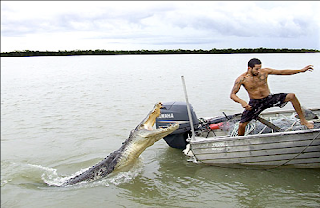
The majority of fatal crocodile attacks are put down as being attacks from the Estuarine or "Saltwater" crocodile (Crocodylus porosus). This crocodile can be found across almost the entire Pacific, from Sri Lanka to the Fiji islands, including the northern territories of Australia. This is the largest surviving species of reptile in the world today, with large males growing to more than twenty-two feet in length and weighing more than one tonne. Although, not as big as a dinosaur such as Tyrannosaurus rex, this crocodile is still an extremely formidable predator and it is responsible for a number of fatal attacks each year. Unfortunately, the number of attacks are increasing. This is due to a number of reasons:
1). Increasing crocodile numbers - poaching in the 20th Century led almost to the extinction of this crocodile species in some parts of its range. Once controls on poaching were put in place and hunting restrictions imposed Estuarine crocodile numbers rapidly increased. More crocodiles in rivers and estuaries has led to an increase in crocodile attacks.
2). Decline in natural game - hunting and habitat clearance, as well as over fishing has led to a decline in the natural prey of these large crocodiles. This is particularly noticeable in countries such as Indonesia. As a result, this has led to a number of crocodiles attacking people close to riverbanks and other bodies of water.
3). Increasing human populations - expanding populations in south-east Asia, the expansion of towns and estates in northern Australia has brought more and more people into contact with large saltwater crocodiles. As a consequence, incidents involving crocodiles have grown dramatically.
4). More tourists exploring known crocodile "hot spots" - the growth in the tourism industry in south-east Asia and northern Australia has led to more people visiting and camping in areas where crocodile attacks are known to have occurred.
Sunday, April 22, 2012
The Simple Ways To Avoid Crocodile Attack

There are only two species of Alligator left in the world. Firstly, as most people know, there is the American alligator (alligator mississipiensis), which can be found widely distributed across the south-eastern United States, most typically in the Florida Everglades. There is also a second extant species of alligator, although this one is much rarer and confined to the upper Yangtse River valley in China. Scientists had thought that the less aggressive alligator had been "weeded out" of its range by crocodiles, leaving the only representatives of the Alligatoridae family in these isolated pockets. The more efficient crocodiles grew faster and may have been better at consuming food but this is generally regarded as speculation - as in the case of the American alligator, this species competes with the native American crocodile (C. acutus). The American alligator can withstand cold spells far better than the American crocodile, and as a result, has a much more extensive range in the United States.
Crocodiles and Alligators kill hundreds of people every year. While most of these fatal crocodile attacks occur in Africa and Asia it is important to note that these powerful reptiles are also found in parts of Australia and America (especially in the Southern States). Humans are typically not part of a crocodile's diet, but in truth they will eat just about anything that moves. They are also very territorial, especially during mating season, and will violently defend themselves even if you mean them no harm. The best option is to give crocodiles and alligators plenty of space and be cautious around water where they may live. In the unlikely event that you are attacked, you may be able to survive if you implement these simple instructions.
1. Stay away from infested waters. This is the simplest way to avoid a crocodile attack. Ask local authorities or residents about the presence of crocodiles in lakes and rivers in your area and don't go swimming outside the designated swimming areas. These animals actively hunt at night when they are hardest to see, so avoid swimming at dusk or at night.
2. If you have spotted a crocodile it is a good idea to stay at least 10 meters away from them so that you have room to escape. Often crocodiles can produce short bursts of speed and can take you by surprise if you are too close. If you are passing a crocodile you do not want to frighten it by coming up behind it. Slap your oars on the water or make a sound so it knows you are there. Crocodiles will sometimes defend themselves violently when they are startled. They are much faster in water so if you know that the water is infested you probably won't want to go swimming or even go near the water.

4. Fighting if you are attacked. If it has you between its jaws it will not let go. The power of their bites are virtually impossible to escape by struggling your way out. Also if you struggle the animal is more likely to do a death roll which is generally what crocodiles do to rip limbs off animals. The best option is to poke or press your finger into its eye. While they have you in their clamp the only way for the crocodile or alligator to escape an eye gouge is to let you go. The eyes are the most vulnerable part of a crocodile or an alligator's body. This is the prime target and it will work nearly every time.
If you cannot reach the eyes for some unknown reason you could also go for the nostrils or ears. Many people have been saved by whacking the snout of a crocodile. This is less likely to work but it may be your only option. If you have been dragged under water you could always go for the palatal valve. Crocodiles and alligators have a flap of tissue behind their tongues that cover their throats and prevents water from getting into their stomach. If you can pry this valve open and allow water to rush down its throat then it will most likely let you go.
Wednesday, April 18, 2012
Attention:The Crocodiles' Speed Beyond Your Imagination

Crocodiles can be transported or subdued for study very simply because of these weak mussels. They could be handled by taping their jaws or holding the jaws together by large rubber bands cut out of automobile inner tubes.
Their teeth are sharp-pointed, inter-locking and are perpetually replaced. A single croc might grow up to 3,000 teeth in its lifetime. How amazing is that? A small bird hops right into the prehistoric estuarine Crocodile's mouth and clean its teeth.
Stay away from infested waters. This is the simplest way to avoid a crocodile attack. Ask local authorities or residents about the presence of crocodiles in lakes and rivers in your area and don't go swimming outside the designated swimming areas. These animals actively hunt at night when they are hardest to see, so avoid swimming at dusk or at night.
Subscribe to:
Posts (Atom)